
Disclaimer: This post is heavily about how AI is hitting the software engineering workforce. I am lucky to be at a company that still does things a lot better, and am very privileged to be in a financial position where I have the time and room to work around tricky situations, but I can't say the same about everyone.
"Man! This job is becoming soul-sucking." There I was, having uttered the words I never thought I would.
The situation was the opposite of what one would think of when thinking about something soul-sucking. In fact, some would even call it "the dream job".
I was more productive than ever thanks to AI Agents, a lot of the things I never liked doing were automated for me, and I could literally build any sort of software I could imagine over a weekend. In essence, I was handed the key to a machine that could churn out anything for me; I was God, and yet, I felt less than I ever had.
Many people reach this level of autonomy and automation and call themselves successful, and yet, this was different. My face at that moment was similar to that of someone saying, "I just make spreadsheets all day" or "I make slide decks no one looks at" or "I calculate things all day for footnotes in presentations."
What was different about this?
Simple. LLMs sucking the meaning out of work.
When I refer to "meaning from work", I am aware that most work had no meaning before anyway, BUT it at least required you to DO something, especially in my field of software engineering. A task, however meaningless, still required a baseline understanding of a lot of complex components and concepts to even get started, which was ultimately the reward function when the task got marked as done.
Instead of asking Claude to analyze this surge of emotions (that would be weird), I have spent a good 2 months talking to people around me who feel similarly and have compiled some of the most key aspects of what's happening in the world.
This post was written in September 2026, and if you're reading this in the future, know that this was written during a period of immense LLM-related progress. To the point that it made a lot of jobs obsolete and meaningless, but those jobs hadn't gone away because of inertia and the continued lack of overall trust in LLMs.
There are two sides to the AI Agent takeover. One is very heavily hit by the takeover.
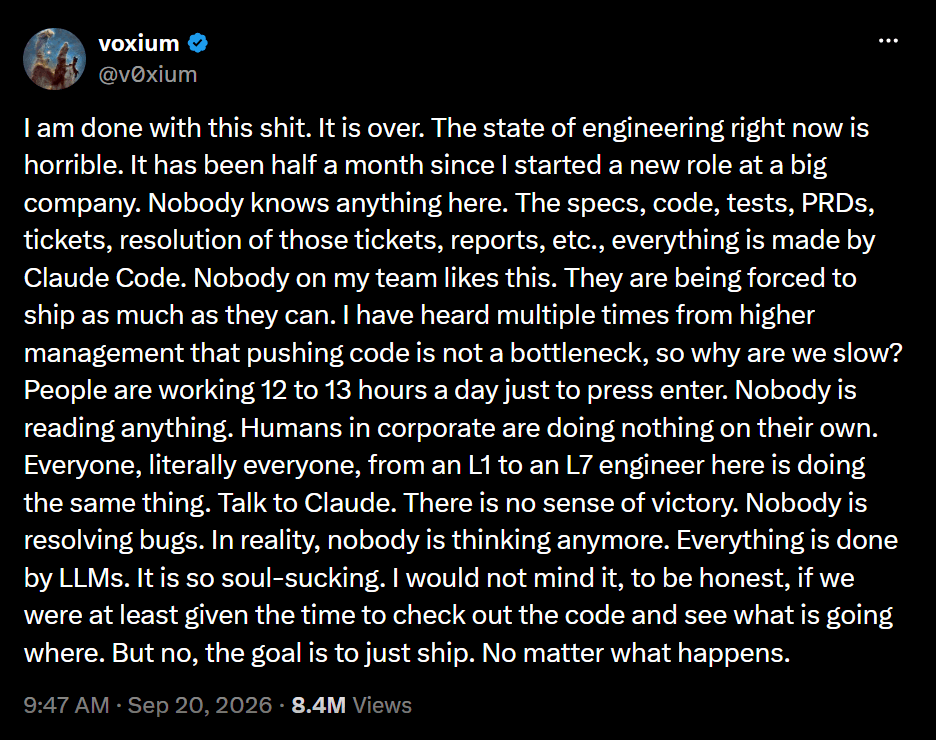
And the other is embracing it for the possibilities it brings.
This post focuses on the first cohort of people because I know for a fact that the second cohort is delusional to a very large extent (reasons in another post some other day).
I also understand that this entire thing isn't a direct problem created by AI Agents, but rather by the humans who have stopped thinking altogether. Something that was weirdly our strongest feature, according to these guys.
Loss of identity
The biggest driver of the soul-sucking nature of one's job is the lack of meaning. I have written about it before in my post about burnouts.
If you don't believe what you do matters, you will lose interest in doing any more of it. This manifests in quicker burnouts.
If you're at a company you believe is doomed, or are working on an internal project you know no one cares about, or are creating spreadsheets and presentations you know no one will glance over for more than a minute, you're bound to lose interest and ask, "What am I even doing?" This isn't unexpected; it's the fundamental nature of our being. We're bound to ask what we're doing because evolution has wired us to.
People have found a way to extract meaning from their work via the things the job enables, i.e., money to travel and buy material possessions, and resources to raise families. But they are all proxies for two things: happiness and fulfilment.
I can see a future where people whose jobs are radically changing gradually move to a mode of thinking where they start treating their jobs as "just a job", but the transition period will be very difficult for someone who has long extracted meaning from the creative nature of their work.
Solving problems with code as a software engineer was immensely satisfying for me, but AI taking that satisfaction away, with no turning back in sight, is an interesting outcome, to say the least. I can see something similar happening to other professions that were heavily creativity-and-knowledge-driven and are now being commoditized.
An uncertain future
All of this would be a great time, but what makes it bad is the future that comes with it. A year ago, these models were nowhere near the capabilities they have today. Moreover, a lot of progress has been made on the quality of the harnesses these AI agents have.
Who knows the kind of stuff these models with increasingly powerful harnesses will be able to do?
This begs some questions:
- What should I even focus on learning?
- Does learning anything even matter?
- What happens to my job? I can already see LLM output being favoured over human output for the speed at which it does things.
- Today, the LLMs have speed as their advantage. Tomorrow, what if the quality improves substantially too?
All the people who told you to "Make AI your ally, people who use AI will not be replaced" 3 years ago have been very silent ever since.
A lot of this progress has even forced me to re-evaluate parts of a blog post I wrote recently about AI fear-mongering.
Not to hold anything against technological advancement, but for a species that works on a set societal framework of study → work → earn → grow, this is surprising. Especially when (and I know it's just theatrics, but the rest of the world seems to be eating this news up the moment it comes out) the largest houses of AI continuously keep fearmongering that AI will replace everyone and lead to mass white-collar displacements.
There are obviously a lot of paradoxes at play today, but in the world of software engineering, we've already seen entry-level job listings cut significantly and new hiring for experienced software engineers reach all-time lows.
Industry "experts" might have opinions, but let me be very clear: none of them have been right about a big chunk of things they have predicted over the last 3 years. So take everything they say with a cubic metre of salt, because we're all experiencing this for the first time in our lives. The industry experts, unless they're the ones who built the LLMs, know not much better than you do. It's a fuzzy world we are living in.
Not to forget, people who don't use their brains for challenging tasks are at severe risk of Alzheimer's. This is an outsider's perspective, but we might end up seeing a rise in Alzheimer's over the course of a few decades.
I can get more done, but what is the point?
I can absolutely produce more, but so can everybody else.
I can build everything, but so can everybody else.
Is what I am building even needed by the vast majority of people, and if yes, would they be willing to pay for it?
Why would someone pay $10 monthly for your product vs. giving $20 to Codex and building a subset of your product that they specifically need? Basic CRUD apps whose entire USP was organizing data for you and charging money for it are going to be the worst-hit products.
And to people saying, "It's your turn to imagine new things now", I say, "Half the people I know are even prompting ChatGPT to give them a million-dollar app idea." The idea that humans are special because they can imagine something new is true, but the vast majority of people you know (including me) are not good at it.
Not to forget, the nature of work has changed, but the same problems are still there because humans aren't exactly very different from before.
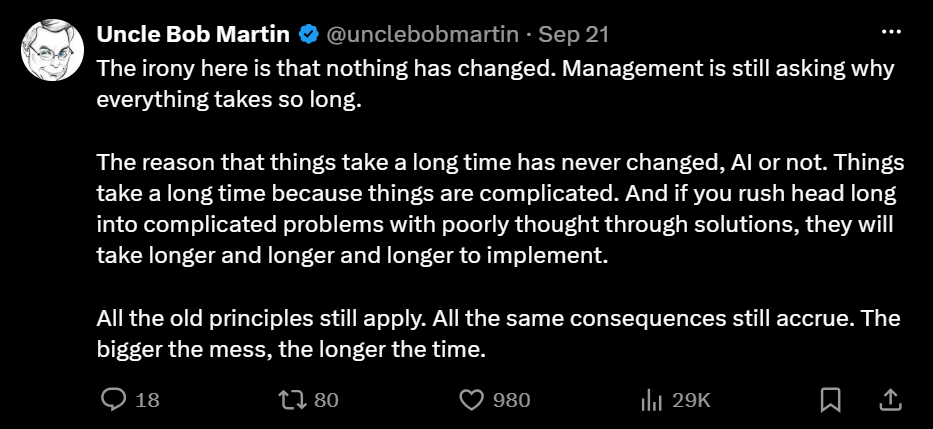
This has led to a different kind of problem: extremely fast executions but poorly thought-through solutions to show that there are productivity gains. Who would have thought?!
This is hitting people who work remotely without human interaction much harder
A big chunk of the meaning and fulfilment people derive comes from community and belonging, or at least the feeling of it. Humans are not meant to carry the burden of life alone. The institution of marriage and a close family exists to take the individual burden of carrying a life, share it across the whole group, and give the people inside it meaning to live for someone other than themselves (how successful it has been in doing that in the past 30 years is something to debate, but you get the gist).
The workers who previously loved working remotely because it took away the grunt work of attending pointless meetings the whole day and allowed them to focus on their craft—code, art, anything that gave their mind a tingle—are finding it more and more difficult to cope with that being taken away from them.
Where does one go when that happens? Their immediate and peripheral support systems—often other humans. Be it family or friends.
People, including me, had no immediate support systems like family and friends living with them consistently because that gap was supplemented by spending the whole day doing what we loved—writing code to solve a problem. I still solve problems, but the parts I enjoyed, solving mysteries in the codebase and architecting things for scalability, have been completely removed.
And it hits much harder than I imagined.
"Oh sure, I can think. But where is the time to?"
I am also hearing versions of these more and more: "Just ask your agent to do it", "Why is it taking time? This should just be one prompt", from people who aren't technical or don't know the intricacies of the task at hand.
"Well, why don't you do it yourself then?" is an appropriate response which unfortunately has to be replaced with diplomatic jargon before it comes out of your mouth.
Fundamentally, the people struggling with agents and their trust in them are the ones who took pride in their craft and cared about the quality of their output. For a software engineer, building a working feature was not the only job; that's the expectation. The job was as much about keeping the code maintainable and scalable for future purposes.
All of those skills translate poorly to LLM SKILL files because they're built on fuzzy, in-the-mind principles and patterns, and not something you can just state as "Ensure any changes you make to the codebase are scalable for future changes".
The industry was already divided between people who cared about what was shipped and people who also cared about how something was built. I belong to the second cohort, and I thus know the perils of how bad agents are at writing code. While the first pass of throwing an agent at a problem solves the issue at hand, it takes a few more iterations and reviews by me to get the code to the point where I would say, "This looks good, let's ship this."
And my prompts are 100 lines long, with excruciating detail. I know of people who write "Fix this" and let the LLM figure out what "Fix" and "this" mean. The increase in the number of PRs is driven by two factors:
- People no longer caring about code quality.
- People in a race to the bottom of who ships more because now you can.
Management will not reward you for shipping more; that's the expectation now. It will, however, reprimand you for not shipping enough because why can't you just type a prompt and get something done?
"Oh sure, I can think. But you don't trust my judgement."
"Have you double-checked this with Claude?"
"No, I literally brought this to you so I can get YOUR review on it."
"Just ask Claude what's missing or what it thinks."
First of all, Claude doesn't think—and I refuse to believe it does, no matter how many times it prints through the UI that it's "Thinking..." with a cute animation next to it.
And second, if you're going to offload the whole judgement part to an agent, what is the point of having you there?
If the answer is for broader vision and strategy, make no mistake that even those are being offloaded to the Claudes and Codexes of the world. I have lost count of how many times I have heard of senior execs typing shitty prompts to Claude with no context of what they're asking and what success actually means, and using the output to run a company.
LLMs are smarter than all of us; it's an understood reality, but let's not pretend like it's not, which is what most senior execs seem to be doing. In fact, I would actually say senior execs at some companies I've seen before are actually lower on the intelligence rung than most people. Just look at the LLM chat history of the execs and how they interact with the LLMs, and you'd know exactly what I am talking about.
Try sending a thought-out message to an exec, and your message will be fed to AI, and you'll receive either a fully AI-generated message or a "Well, Claude says..." response.
"Oh sure, I can think. But no one else is. I'm going through 10 shitty Claude artifacts every day."
There are 100 artifacts generated by people at every company. No one reads them; they task their Claudes or Codexes to read them and summarize them for them because God knows what language Claude has written the artifacts in (I would like to believe I am an extensively well-read person, but even I have a hard time reading the version of English Claude uses).
The initiator of the chain never reviews the artifact generated; the receiver tasks his Claude to check what has been sent. It's just Claude talking to itself via different people.
The final artifact generated is then compiled into 3 bullet points. People are forgetting that even today, models hallucinate, and yet there are management decisions being taken based on these analyses—real decisions that impact the lives of people.
"I just want to quit and move to the mountains, man!"
This is a compilation of what I've heard from a lot of people lately. Call it selection bias or a skewed observation set. I know there are a lot of people who feel great about prompting their way to outputs, but I don't like these people. Because these are the same people who, in the past, were noisemakers instead of executors (the people who would jump from meeting to meeting just giving their opinions and never actually getting their hands dirty in executing them) and lacked second- or third-order thinking.
"I wish I could retire."
"I just want to get a different job, something where I can use my mind and move my body."
"I just want to quit and move to the mountains, man!"
"Let me see. A couple of years down the line, I don't see myself doing this if it continues."
Now, how much truth there is to these words, and whether these people will forego a still-pretty-good paycheck to do something else when the opportunity presents itself, is a question only time can answer.
I now get it.
It used to be a confusing moment whenever I heard someone say "I hate my job" or "I don't like working", as my head always kept on wondering why someone continues to work if they hate their job.
I now understand the lack of meaning in a lot of other existing work that was behind those statements, and honestly, even if I wanted to leave, it would be very hard for me to do so because of a few reasons:
- The paychecks are really good, even after AI has come in, at least for a while. This allows people, including me, to live out a comfortable life and build significant buffers for when we do eventually need to rethink and leave.
- While many professions ask you to constantly keep learning new things to do your job better, leaving and switching careers requires two very important traits:
- Embracing learning something new from scratch—this is often much more difficult than people think.
- The courage (or ego) to say "I quit" and also be ready if the switch doesn't go as planned.
Not everybody has it in them to go through with it unless circumstances absolutely force one to do so. Which, I personally predict, will happen sooner or later for a mass-displaced group.
It has been a recurring theme that jobs get removed and then replaced by other jobs, and the economy shifts accordingly.
The UK is a good example of a few major cities driving all the economic output of a country, while the rest lags behind because the output they produced has been outsourced to cheaper locations. Ask the folks in rural UK, which once used to be a place where people came to work in factories in droves and prospered with remittances, and they'll tell you that it's never been the same. They still survive, somehow, but not with the same level of wealth and quality of life that their ancestors once enjoyed.
It is even scarier for a country like India that has built a big chunk of its exports in the form of IT services to the rest of the world. We have a lot of smart people here, but that doesn't mean a majority of the country's IT-BPO employment isn't coming from Indian wages being cheaper than US or UK wages. What happens when those wages become more expensive than GPUs?