
Picture this, and I promise I don’t mean for this to sound like a LinkedIn motivational post.
I had gone on a beautiful trek in the Himalayas. It had these stretches where you had to jump across rocks and boulders to move forward.
For context, I am a very healthy individual who has a lot of fun doing these things, but it was my first time doing something like this with strangers who were not as agile as your average trekking group.
The thing you notice with first-timers is that for even small gaps, they would spend a lot of time “thinking” or “worrying” about the jump they have to perform. Once a jump was done, they would move on to worrying about when and how they would do the next jump. To be honest, none of those jumps was a big deal, and everyone went through unscathed.
We’re usually far more capable than we think. It’s only after we take the leap that we realize it wasn’t that big of a deal.
Think about breathing. It’s the most natural thing your body does effortlessly, all day. But the moment you start consciously thinking about taking every breath, it suddenly feels heavy. Even uncomfortable.
Ever stood on the edge of a building that was adjacent to another? The distance between the two is very small, and most people can jump, but the limiting factor is always “What if I slip?” or “What if I am not able to make it?” It’s the “What if”s that stop us. And that’s all you need to know about limiting factors. Jumping 3 feet between two building roofs isn’t any different from jumping 3 feet on the ground. It’s the fear of what-ifs that differentiates the two.
I personally think, as kids, we jumped and moved around more easily because we just didn’t think too much about it BEFORE we jumped. Physiology plays a big role, but most of us today are capable of jumping from a wall, which we did frequently as kids, even though we were half the size, and yet we worry about jumping from heights as low as our beds, because we obsess over what is going to happen if we sprain our ankle or pull a muscle.
What does all this have to do with this post? Simple. This post is about a few principles about life and career-building I believe in, that link to whatever I have mentioned above:
- Do not obsess over every little detail.
- "Act" when there is sufficient information available.
- Understand that you can get more information only after acting.
When you’re going through your daily dose of YouTube, you’ll encounter some unfathomable bits of wisdom in the comments (Mostly humour that is brain-dead, but sometimes true wisdom). One such piece of wisdom I absolutely love is:
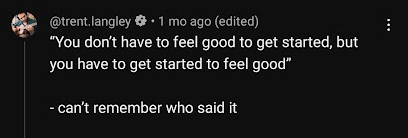
I love this because it doesn’t just apply to your daily tasks when you’re procrastinating, waiting for the right moment to hit you to get started (Spoiler: The right moment is usually after you start), but it even applies to larger projects that stay fixated on planning every little detail to perfection.
Teams, at the end of the day, are the people that comprise them, and thus, teams will have biases and instincts. As such, a team that is filled with people who are procrastinators will also end up procrastinating.
Sometimes, procrastination isn’t born just out of not wanting to do something; it is waiting for the right moment or the right information to come to you before you start.
This post is about letting go of the urge to plan or wait till the last moment to do something, and embracing that you have to start, regardless, and figure things out as you go.
A couple of common criticisms of this approach I have heard are:
- "If I don’t plan for things, I’ll end up doing a shoddy job."
- "There are things that just HAVE to be planned, you can’t follow this mantra blindly on everything."
And they’re both valid, to an extent. But this post is about knowing when planning becomes over-planning, especially for things where failure doesn’t carry huge consequences.
Planning helps you understand what could go wrong. But over-planning often stops you from finding out what actually happens.
Figuring out things as you go is not equal to doing a shoddy job, hold yourself to high standards
“Oh, if I don’t plan enough at the beginning, I’ll end up doing a shoddy job” No. That’s not how it works; the quality difference often comes from a lack of execution and not a lack of planning.
Planning decides what is possible and how to get it done, whereas the quality of execution decides the quality of what is shipped.
Now, like all rules in the world, there are certain exceptions where planning does become important to the quality of the job. For example, the kind of architecture to use in an important backend system.
But these are often abstractions and act as a means to an end. Chances are that different architectures lead to a sufficiently good outcome for the end user. I don’t have to iterate over the number of products out there that run on broken architectures, but make users very happy because they deliver on the value needed. This is the whole point of a Minimum Viable Product: an entire Lean-Startup movement is built around getting things done and not worrying too much about the details or figuring them out as you go.
Paul Graham wrote an article that liberated several startup founders and leaders from overthinking every move and allowed them to be okay with not having all the information when trying to build something or get something done.
A couple of my personal opinions on this:
- If you’re good at your job, you’re already capable of delivering a decent outcome basis your knowledge and execution skills. If not, then first learn how to be good at your job.
- If you hold yourself to high standards when delivering something, you’ll spend more time in the right phase: Execution. This serves as a reinforcement loop of learning what works and what doesn’t.
The Irreversibility/importance of something vs amount of time needed for planning curve
There’s this very interesting curve on how important something is, and how much time you should spend planning. The same curve also works on how “irreversible” doing something is, something Jeff Bezos famously notes as one-way and two-way doors.
Jeff Bezos explains one-way door decisions and two-way door decisions.
For instance, changing the direction of a company on the basis of something completely experimental without much thought would be foolish. However, if you have collected enough information and can work your way through saying, “Okay, if this works out, it’ll be huge, and I’m willing to take the risk”, you can do so with conviction. That conviction only comes from spending enough time thinking about something and not doing things purely on a hunch.
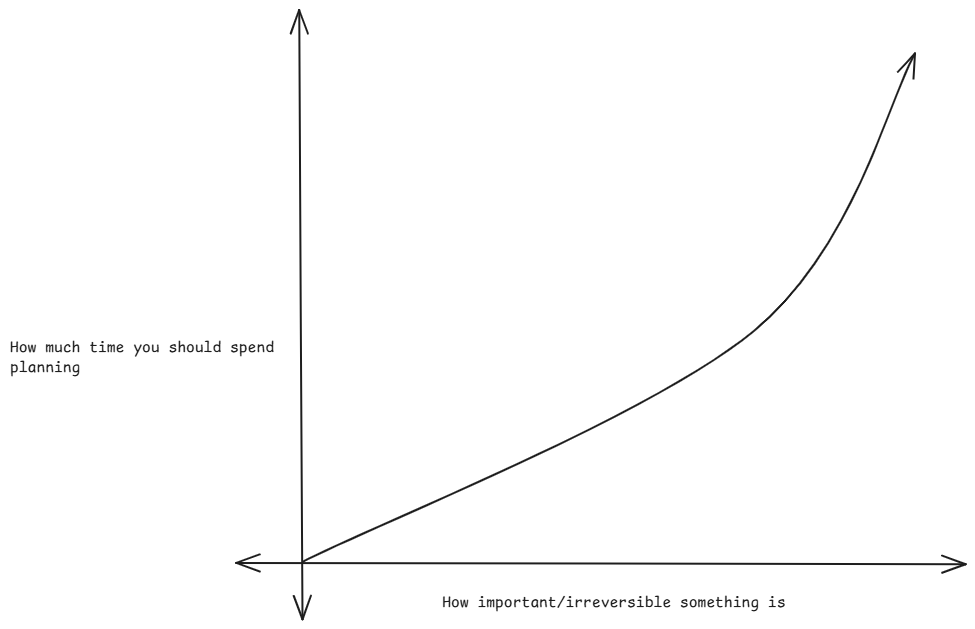
At the same time, if you’re running a pilot project where the chances of going wrong may be high, but it also doesn’t involve any long-term setbacks, then you can spend no time thinking about it and just go for it, with learning as an outcome.
This is an important point to remember, because it classifies what you do in life as a set of bets and strategies.
At the same time, this curve is a generalization and not a rule. Something can be important AND not need a lot of planning upfront; there are cases where sitting down to think and plan would actually take more time than the task alone. Imagine, in the case of an accident response, a plethora of lower-stakes but still important tasks we undertake on a daily basis.
The irreversibility/importance vs amount of information needed curve
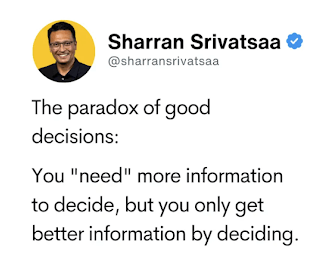
There’s another curve that’s an extension of what we talked about above. It relates the amount of information you would need to get started to the irreversibility of what you’re trying to achieve. When you spend no time planning, you have some information that’s relevant (Note that the amount of information isn’t 0; you should still have some idea instead of throwing darts in the dark).
But the lack of information isn’t a pitfall because something that isn’t very important doesn’t need all the information in the world to get started. Gathering more information will cost more time than just getting the job done, and you’ll most likely just get the information as you go.
But at the same time, if the job you’re undertaking is irreversible, the amount of information needed increases.
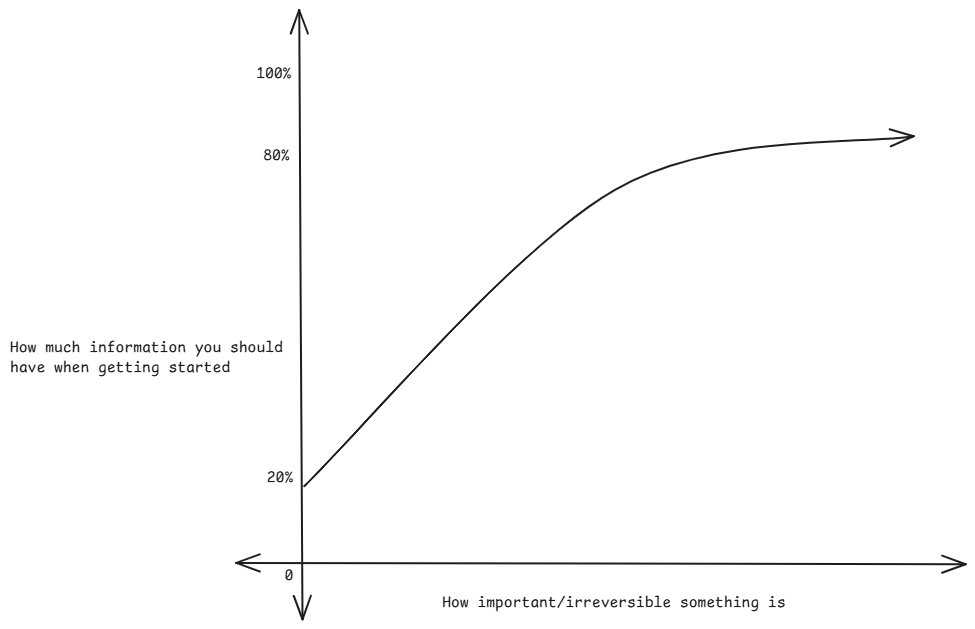
Notice that the curve flattens and never reaches 100% (even the numbers 20% or 80% are abstract numbers for the sake of giving an idea). The simple reason? Execution, i.e., getting started, is a part of the information-gathering process. In fact, it is the most integral one. You can have all the meetings and ready all the plans, but execution is where the final bit of “Oh, we probably didn’t think of this” comes up. And you would be surprised how many jobs are usually planned to perfection but break down in execution.
Several airports today lie empty, several infrastructure projects lie unfinished, not because the group building them didn’t have the best in mind, they just didn’t account for one or two major things, which came up only AFTER they started work, and that’s okay, this is part of the process.
There are also projects that never make it past the drawing board or the meeting rooms because the teams are hellbent on getting every single detail right. There is a term for this: Analysis-Paralysis. You spend so much time analysing that you are afraid to even go ahead, purely by the fear of something else coming up, even though it should have reduced your anxiety about the job.
When you’re working on something extremely critical such as a space launch, or something where lives are at stake, it makes sense to get these details right and try stretching the curve as close as possible to 100%, but it is like a mathematical derivative function (Anyone who’s learned Limits as a concept will know what I am talking about), it never touches the 100% mark.
Some examples from my career
One of the things I believe is walking my talk, i.e., practicing what I preach.
At the beginning of your career, you’re paid to learn; the company that employs you is effectively investing in you to become a resource in the long run and help out with the context you build over time. At this point in time, it is important that you say yes to as many things that cross your desk.
I know most people make a big deal about choosing the right things at the right time, so you concentrate on impact, but there are a few reasons that argument falls apart:
- In the beginning, you don’t know what will generate the most impact.
- In the beginning, you don’t know what you don’t know.
The only way forward is to say yes to whatever comes across your desk, do a better-than-satisfactory job at those things and then just learn for yourself.
“But if I fail at my tasks, wouldn’t that look bad for me?” No, anyone who looks down on someone for failing at something for the first time isn’t someone you should be worried about. If, after you’ve put in the effort and got some information, you realize something isn’t possible, being honest about it garners you more respect and help from others.
That is precisely what I did when I started my career, and it’s paid dividends hundreds of times over. Things like:
- Picking up things that others weren’t ready to pick because of the complexity involved, even if you make some progress, you’ll garner huge admiration from everyone else. Plus, at the beginning of your career, your time isn’t as valuable as others far senior to you; it’s a win-win for everyone.
- Starting things without full information and making my way through the ambiguity.
- Need a test suite completed for a new project? Sure.
- Need documentation for a legacy project? Done.
- Need an entire project migrated over from JavaScript to TypeScript? I don’t know how to do it, but let me try and let you know.
- Need a mobile app done for this product we’re launching? I don’t build mobile apps, but sure, let me try and learn on the way.
Most of this happened at startups, where I was one of the few - if not the only engineer - working on the team. It is also why I’m a huge proponent of working at startups early in your career. It builds agency and skills that you just would never get working at a larger established company. Established companies help you build deep expertise in one domain, and startups expose you to multiple domains where you get to choose what you like.
In most cases, the learning that comes from things not being possible is still valuable and has stayed with me to this day. If a project succeeded, great; if it didn’t, well, no big deal. I then knew what wouldn’t work and could recognize it from a mile away in the future, saving a ton of time over my career. And trust me when I say this, careers are long, life is long. You never know what learning comes in handy where.
Agency, the ability to get things done and the routine of working with limited or no information and finding your way through ambiguity are skills that are never out of demand.
They’re all skills that can be developed, they’re muscles that build from doing them more and more. You just have to make sure your effort is channelled in the right place, and things will fall into your favour over time.